How to Scale Team Productivity Without Sacrificing Standup Efficiency
Let's be brutally honest: many of your team's daily standups are probably draining more energy than they generate. You know the drill – a quick check-in that somehow morphs into a rambling status update, a debate, or worse, a silent ritual where everyone just goes through the motions. As a Senior Tech Writer at Standupify, I’ve seen this pattern repeat across countless engineering and product teams. In an era where 79% of employees spend at least some time working remotely, and 52% navigate hybrid setups, the casual "pop over to someone's desk" for clarification is a relic. Your team’s scattered nature makes coordination exponentially harder, turning what should be a concise alignment into a potential productivity sinkhole.
The Invisible Drain: Why Standups Fail to Deliver
The core problem isn’t the standup itself; it’s the lack of a clear, focused system around it. If your team consistently feels unhappy with what they accomplish, there's a good chance they're falling into common productivity traps. One major reason is simply not knowing which activities truly matter. It’s easy to get bogged down in the small stuff, believing there’s time for everything, while the big, impactful work remains untouched. This isn't just about individual procrastination; it's a systemic issue that impacts collective output. Research indicates that ignoring individual preferences and failing to identify "magic activities" that accelerate progress are significant hurdles to productivity.
Another silent killer of standup effectiveness is distraction. In a world of constant notifications and overlapping projects, team members often struggle to define what success looks like for a given task, leading to inertia. As productivity experts note, sometimes procrastination isn't about unwillingness, but simply not knowing where to begin. Without clear objectives and a system to dump distractions, your standups become a platform for reporting on busywork, not progress.
Prioritization Isn't Just a Buzzword: It's Your Team's Lifeline
The answer to standup chaos isn't more meetings; it's better prioritization. For remote and hybrid teams, this isn't optional—it's foundational. When your team is geographically dispersed, you can't rely on osmosis for alignment. You need a robust, explicit system. This is where frameworks like the Eisenhower Matrix, the 80/20 Rule (Pareto Principle), and the MoSCoW Method become invaluable. They provide a common language and a structured approach to identifying what's truly "Must Have," "Should Have," "Could Have," and "Won't Have" (MoSCoW) for the day or sprint.
Building Your Daily Prioritization Ritual
A truly effective daily standup should be the culmination of a personal and team prioritization ritual, not the start of it. Consider this three-part approach, as advocated by productivity specialists:
- Morning Planning (10-15 minutes): Before the standup, each team member defines their top 1-3 priorities for the day. What are the "magic activities" that will move the needle? This isn't just a mental exercise; it needs to be documented.
- Midday Check-in (Flexible): A quick, asynchronous check-in to adjust priorities if needed, especially in agile environments where things shift rapidly. This is where a google chat standup bot like Standupify shines, allowing for quick updates without interrupting flow.
- End-of-Day Review: A brief reflection on accomplishments and setting the stage for tomorrow. This helps reinforce accountability and provides a sense of closure.
When everyone arrives at the standup with a clear understanding of their own priorities, the conversation shifts from "what did you do?" to "what are you doing that matters most for the team today, and what blockers do you have?" This drastically improves standup team efficiency, ensuring everyone is aligned on the vital few tasks.
Automate the Mundane, Amplify the Meaningful
Here’s where technology becomes your indispensable ally. Manual standups, chasing updates, and compiling reports are precisely the repetitive tasks that kill productivity. McKinsey research reveals a staggering truth: 60% of employees could save 30% of their time with workflow automation. That translates to recovering a full 12 hours a week from a standard 40-hour work week! Furthermore, 51% of employees spend at least two hours a day on repetitive functions that can be automated, and companies leveraging workflow automation save an average of $46,000 per year. An impressive 85% of managers report that automation helps employees save 10-50% of their time previously spent on these tasks. These aren't just abstract figures; they represent real dollars and hours you can reinvest into innovation and critical problem-solving. (Source)
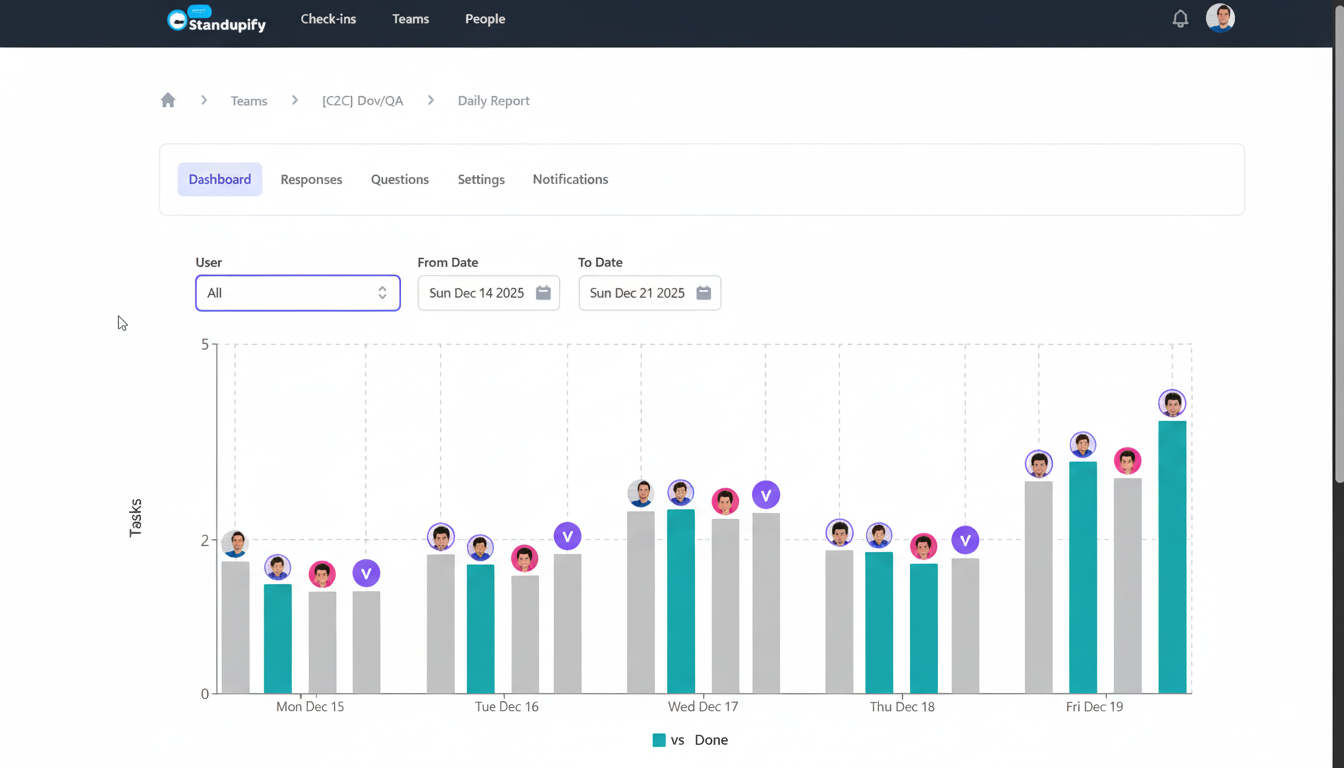
This is precisely the gap a dedicated google chat standup bot like Standupify fills. Imagine a world where your daily standup updates are collected asynchronously, aggregated intelligently, and integrated directly with your task tracker (like Jira). Blockers are highlighted, progress is transparent, and team members can focus on their work, not on recalling every detail for a meeting. This isn't just about saving time; it's about fundamentally reshaping how your team collaborates, driving genuine standup team efficiency.
Building a Culture of Continuous Improvement
Optimizing daily standups is a critical step, but true team productivity is a continuous journey. It requires a culture that embraces feedback and adapts. Beyond the daily check-ins, regular retrospective meetings are crucial for identifying systemic issues and celebrating successes. These sessions provide an invaluable opportunity to reflect on what went well, what could be improved, and how the team can evolve its processes.
Integrating insights from your standup bot into your retrospectives can be a game-changer. Imagine having clear data on persistent blockers, common distractions, or areas where prioritization consistently fell short. This data-driven approach elevates the retrospective from subjective discussion to actionable planning. For a deeper dive into how bots can revolutionize these crucial meetings, check out our post on Elevating the Retrospective Meeting in Agile with Standup Bots and AI Insights. By consistently reviewing and refining your processes, you build a resilient, high-performing team.
The Bottom Line: Your Team Deserves Better Than Mediocre Standups
In 2026, the demands on engineering managers, team leads, scrum masters, and product managers are higher than ever. You can no longer afford the hidden costs of inefficient meetings and misaligned priorities. By embracing robust prioritization frameworks and leveraging the power of automation with a dedicated google chat standup bot, you can transform your team's daily check-ins from a chore into a powerful engine for progress. It’s about creating an environment where every minute counts, every task is purposeful, and your team’s collective energy is channeled towards what truly matters. Isn't it time your standups stopped stalling progress and started accelerating it?