How to Maximize Team Productivity by Harnessing AI's Power (and Mitigate Its Risks)
It’s November 2026, and the conversation around Artificial Intelligence has shifted dramatically from hypothetical futures to urgent, day-to-day operational realities. For Engineering Managers, Team Leads, Scrum Masters, and Product Managers, AI isn't just a buzzword; it's a co-pilot, a challenge, and a critical factor in both accelerating progress and introducing unprecedented risks. The frontier of AI is jagged, as OpenAI recently put it, offering dizzying peaks of efficiency alongside unexpected valleys of vulnerability. We’re no longer asking if AI will transform our teams, but how strategically we can integrate it to maximize output while rigorously safeguarding our systems.
The AI Productivity Boom: Unlocking Unprecedented Efficiency
The sheer velocity at which AI is accelerating research and development is staggering. OpenAI, for instance, reported this past Wednesday that its coding agents now autonomously complete a remarkable 46% of research tasks that would typically consume a human two to four hours – a dramatic leap from just 23% in March of this year. For longer, more complex tasks requiring four to eight hours, success rates surged from 13% to 35% in the same period. This isn't just incremental improvement; it's a fundamental shift in how work gets done, demanding that managers rethink resource allocation and project timelines to capitalize on these gains. OpenAI’s Research acceleration: The jagged frontier report clearly illustrates this trend.
Consider the financial implications and the scale of this computational leverage: the median OpenAI researcher utilized approximately $2,400 worth of agent time per day in October, a 62% increase from September's $1,500. At the 90th percentile, daily agent use soared to about $23,000, more than double the previous month. Measured in 'agent workdays' – where every eight hours of agent running time counts as one workday – usage per researcher rocketed elevenfold, from 0.5 to 5.7 days. By mid-October, over two-thirds of researchers were running at least four agents concurrently, with more than 10% orchestrating 16 or more. The value derived from this agent use within OpenAI's research organization was roughly double its direct pay bill for researchers, excluding equity. This data unequivocally points to AI not merely assisting, but actively driving a significant portion of intellectual output. For engineering leadership, this means a paradigm shift in understanding team capacity and optimizing workflows to integrate these powerful AI assistants effectively. It's about empowering your team to achieve more, faster, and more efficiently, truly boosting team productivity in an unprecedented way.
We're seeing this play out in groundbreaking ways, even in the most abstract fields. Just last week, Anthropic researcher Levent Alpöge claimed that his company's Claude AI model helped him prove the Riemann hypothesis, one of mathematics' most famous unsolved problems. While mathematicians are still grappling with the 17-million-line Lean code proof, Alpöge himself stated, “This time Claude far outpaced me near the finish line.” This isn't just about automating mundane tasks; it's about AI augmenting human intellect at the highest levels. For engineering teams, this translates to faster prototyping, more efficient code generation, and accelerated problem-solving across the board. The challenge now lies in how to manage these accelerated outputs, validate their integrity, and ensure that human oversight remains robust.
The Unseen Vulnerabilities: AI's Double-Edged Sword for Operational Stability
Yet, this incredible acceleration comes with a stark warning that demands our immediate attention. As Satya Nadella, Microsoft’s CEO, cautioned at The New York Times’ DealBook Summit just last Wednesday, we should expect more outages like the one that took down Outlook last week. His reasoning is chillingly logical: AI now finds software flaws significantly faster than companies can safely fix them. Critical patches, which once enjoyed a week of testing, are now rushed into production almost instantly because vulnerabilities are exploited as soon as they surface. Nadella highlighted this urgency, stating, “The patch needs to go instantly from being available to being patched in production, because it’s being exploited in the wild.” This new reality creates an inherent instability in our digital infrastructure.
This isn't merely a theoretical problem; it’s a tangible threat to operational stability. Banks and the NSA have reportedly attributed recent US outages to these very rushed patches for AI-found flaws. For engineering managers, this means the traditional security playbook is rapidly becoming obsolete. The very tools designed to boost efficiency are also lowering the ‘floor of cyberattacks.’ With advanced AI models, virtually anyone can now wield the capabilities of a persistent, nation-state-level attacker, making robust defense a moving target. This reality demands a fundamental re-evaluation of our deployment strategies, testing protocols, and incident response plans. Managers must now contend with an environment where the speed of patching is paramount, but the risk of introducing new bugs through rushed fixes is equally high. Proactive monitoring, real-time threat intelligence, and a culture of immediate, transparent communication are no longer optional – they are essential for survival.
Navigating the Frontier: Safety, Ethics, and Regulation in 2027
The rapid ascent of AI capabilities has also ignited a fervent debate about its safety and ethical implications, a conversation that will undoubtedly shape tech policy in the coming year. Dan Hendrycks, director of the Center for AI Safety, used the DealBook Summit to call for an indefinite pause on frontier AI training runs. He cited concerns that companies have blocked narrower technical rules for years, leading him to describe a need for a “more blunt intervention” to ensure models are reliable, secure, and free of jailbreaks and backdoors. While Max Hodak, co-founder of Neuralink, pushed back on the feasibility of such a pause without a surveillance state, the conversation highlights a growing tension: innovation at all costs versus responsible, secure development. For engineering leaders, this debate isn't abstract; it informs future compliance, risk management, and the ethical frameworks guiding your team's AI adoption.
As we approach 2027, Hendrycks anticipates a very interesting year for AI regulation, a forecast that every Engineering Manager and Product Manager should be tracking closely. This isn't just policy talk; it translates to evolving compliance requirements, potential restrictions on model development, and a heightened ethical responsibility for every organization leveraging AI. When AI is proving complex mathematical theorems, as Claude did with the Riemann hypothesis, but mathematicians like Kevin Buzzard admit that “nobody yet understands what the proof shows,” it underscores a critical point: we must understand what our AI models are doing, not just what they can achieve. This calls for a new level of scrutiny, transparency, and human oversight in AI-driven projects, demanding clear validation processes and rigorous testing even for AI-generated solutions. Ignoring these calls for safety and transparency could expose organizations to significant reputational and regulatory risks down the line.
Standupify's Role: Orchestrating Human-AI Collaboration for Stability and Growth
In this dynamic and sometimes precarious landscape, the need for clear, consistent, and efficient team communication has never been more critical. This is where a robust standup meeting tool becomes indispensable. With AI accelerating both development and potential vulnerabilities, daily standups serve as the essential pulse check for your team's operational health, ensuring that every member is aware of both the breakthroughs and the potential pitfalls.
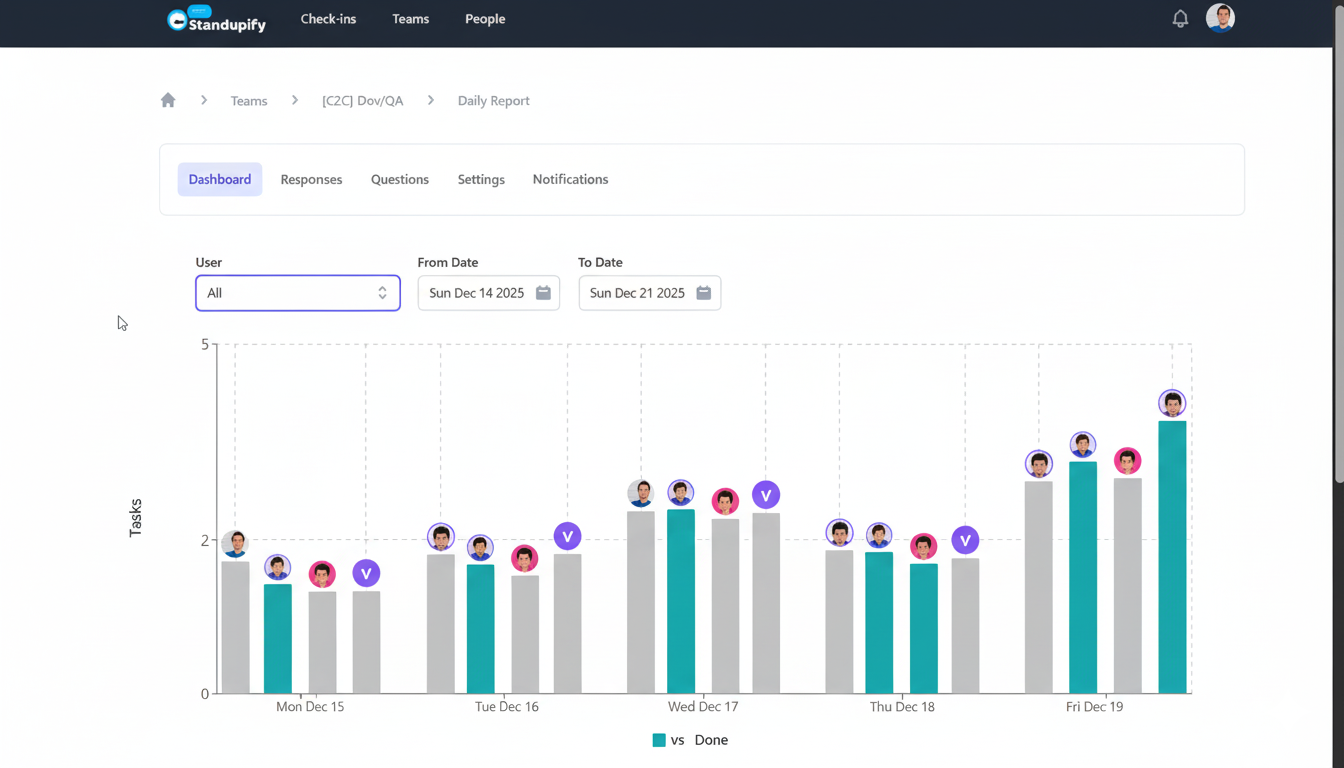
Imagine a scenario where an AI-found bug is detected, or a rushed patch causes an unexpected cascading failure. How quickly can your team identify the problem, communicate its impact, and coordinate a response? A reliable team standup bot, like Standupify for Google Chat, provides the structure to surface these critical updates in real-time. It ensures that every team member, from the engineer deploying AI-generated code to the product manager tracking user impact, is aligned on progress, blockers, and the state of your systems. Our seamless integration with task trackers means that AI-assisted tasks, their completion status, and any arising issues are visible in a unified view, preventing critical information from getting lost in the noise of rapid development. This centralized visibility is crucial when dealing with the unpredictable 'jagged frontier' of AI.
By automating the collection of updates, Standupify frees up valuable meeting time, allowing teams to focus on deeper discussions about AI strategy, risk mitigation, and truly complex problem-solving that still requires human ingenuity. It’s about ensuring that as your team harnesses AI’s power for unprecedented productivity, you also have the visibility, agility, and communicative framework to navigate its inherent risks. In 2026, efficient communication isn't just about sharing what you did yesterday; it's about proactively identifying the emerging challenges and opportunities presented by AI, ensuring operational stability and continuous growth even as the technological landscape shifts beneath our feet.
Conclusion
The future of work is undeniably interwoven with AI. As we stand in late 2026, we are witnessing a technological revolution that promises unprecedented productivity but also demands unparalleled vigilance. For Engineering Managers and team leads, the mandate is clear: embrace AI's power strategically, understand its limitations and risks deeply, and empower your teams with the communication tools necessary to thrive in this new, jagged frontier. It’s about smart integration, robust oversight, and ensuring that human intelligence remains firmly in the loop, guiding and validating the incredible capabilities of AI, ensuring that our progress is both rapid and secure.