The Future of Team Productivity: Reclaiming Energy and Control in 2026
Let's be brutally honest: for years, we’ve been tackling team productivity with the wrong mindset. We’ve treated overwhelm as a workload problem, believing that if we just had a better system, a tighter calendar, or more aggressive prioritization, everything would fall into place. But what if I told you that, for the majority of teams, this approach is fundamentally flawed? As we navigate 2026, the most forward-thinking engineering managers, team leads, and product managers are realizing a profound truth: overwhelm isn't primarily a workload problem; it's an energy and control problem.
This isn't just my opinion; it’s a perspective increasingly supported by productivity experts and real-world team performance. We’ve been so focused on managing time, we've neglected the two other critical currencies of productivity: energy and attention. The result? Teams burning out, feeling perpetually behind, and struggling to maintain velocity even with the most sophisticated task trackers.
Beyond the To-Do List: The Energy Economy of Teams
Think about your own day. Have you ever noticed that some days, a seemingly light workload feels crushing, while on others, you power through a packed schedule with ease? Productivity research has shown that our alertness peaks and valleys are often predictable. For many, peak sharpness occurs between 9 AM and 11 AM, followed by a noticeable slump around 1 PM to 3:30 PM, where complex thinking becomes genuinely painful. This isn't laziness; it's biology. Ignoring these natural rhythms is like trying to drive a car on an empty tank and wondering why it stalls.
Now, scale that to a team. If individual contributors are consistently scheduling their hardest work during their energy valleys, or if they're perpetually running on broken sleep and unresolved stress, their collective output will inevitably suffer. A recent deep dive into human energy patterns highlighted how rarely individuals design their days around these predictable cycles, often scheduling easy tasks during peaks and hard thinking during slumps. Imagine the cumulative drag on a team when this pattern is endemic. According to a piece on Asian Efficiency, if you sleep well for 4-5 consecutive nights, it's genuinely hard to feel overwhelmed; the same workload feels manageable. Overwhelm Is an Energy Problem, Not a Workload Problem.
The Hidden Cost of Reactive Work
Teams often find themselves in a perpetual state of reactivity. Emails pile up, urgent requests interrupt focused work, and context switching becomes the norm. This constant firefighting drains mental energy far more than focused, deep work. It’s like trying to run a marathon while constantly stopping to tie your shoelaces. This reactive mode is particularly damaging when team members return from time off.
Consider the '1-for-4 Rule' for individuals: for every four days away, schedule one catch-up day upon return. This isn't a normal workday; it's dedicated time to process, orient, and get current. Most people, however, land expecting to run at full speed, starting from a deficit. The same principle applies to teams. Without structured recovery and proactive planning, a team returning from a major project delivery or even a collective holiday can take days, if not weeks, to regain full momentum. This isn't just anecdotal; it's a pattern observed in coaching clients who traveled 3-4 times a month and consistently felt overwhelmed upon return. The 1-for-4 Rule: How to Stop Coming Home from Trips Already Behind offers powerful insights into this often-overlooked aspect of productivity.
Reclaiming Control: The Power of Intentional Resets
When teams are overwhelmed, the natural inclination is to seek a new system – a new project management tool, a different agile framework, or a more rigorous meeting schedule. But if a team is in full overwhelm mode, adding a new system is like trying to reorganize a closet during an earthquake. It rarely helps, and often exacerbates the problem. The real diagnosis of overwhelm, especially at a team level, is a loss of control, not a loss of time.
What teams truly need are intentional resets. This could be a quarterly offsite focused purely on strategy and alignment, a 'no-meeting Friday' dedicated to deep work, or even individual 'reset days' that encourage stepping away from the daily grind to regain clarity. Personal anecdotes from productivity experts highlight the transformative power of such resets: a 48-hour digital detox and fasting trip led to clear-headedness and renewed energy, lifting a fog that had lingered for months. This wasn't about adding, but about subtracting and creating space. When You’re Overwhelmed, You Don’t Need a New System. You Need a Reset, emphasizes this critical shift in perspective.
The 'Fresh Start Effect' for Teams in 2026
The concept of a 'fresh start' isn't just a feel-good notion; it's a powerful psychological phenomenon. Research by Katy Milkman on the 'Fresh Start Effect' shows that temporal landmarks – like Mondays, the start of a new month, or even a new fiscal quarter – boost motivation and make it easier to adopt new habits. Teams can harness this by intentionally creating 'fresh starts' within their workflow.
Automated daily standups, for example, serve as micro-fresh starts. Each morning, a well-structured standup offers a clean slate, a chance to articulate progress, identify blockers, and set intentions for the day. This reduces the cognitive load of remembering everything from yesterday and provides a clear path forward, combating the feeling of lost control. This psychological clean slate is a secret productivity weapon for high-performing teams, as explored in the podcast Why a Fresh Start is Your Secret Productivity Weapon (TPS608W).
Standupify: Your Ally in the Energy and Control Economy
This is where Standupify shines. Our mission is to empower teams to reclaim their energy and control, transforming daily standups from a chore into a powerful catalyst for productivity. As a dedicated google chat standup bot, Standupify integrates seamlessly into your team's existing workflow, automating the collection of updates, surfacing blockers, and providing real-time insights into team progress.
By streamlining the standup process, Standupify reduces the mental overhead for each team member. No more wasted time in synchronous meetings that could be asynchronous. No more scrambling to remember what you did yesterday. Our bot prompts team members for their updates, allowing them to contribute when their energy levels are optimal, not just during a scheduled meeting slot. This not only respects individual energy patterns but also ensures that critical information is captured consistently and efficiently.
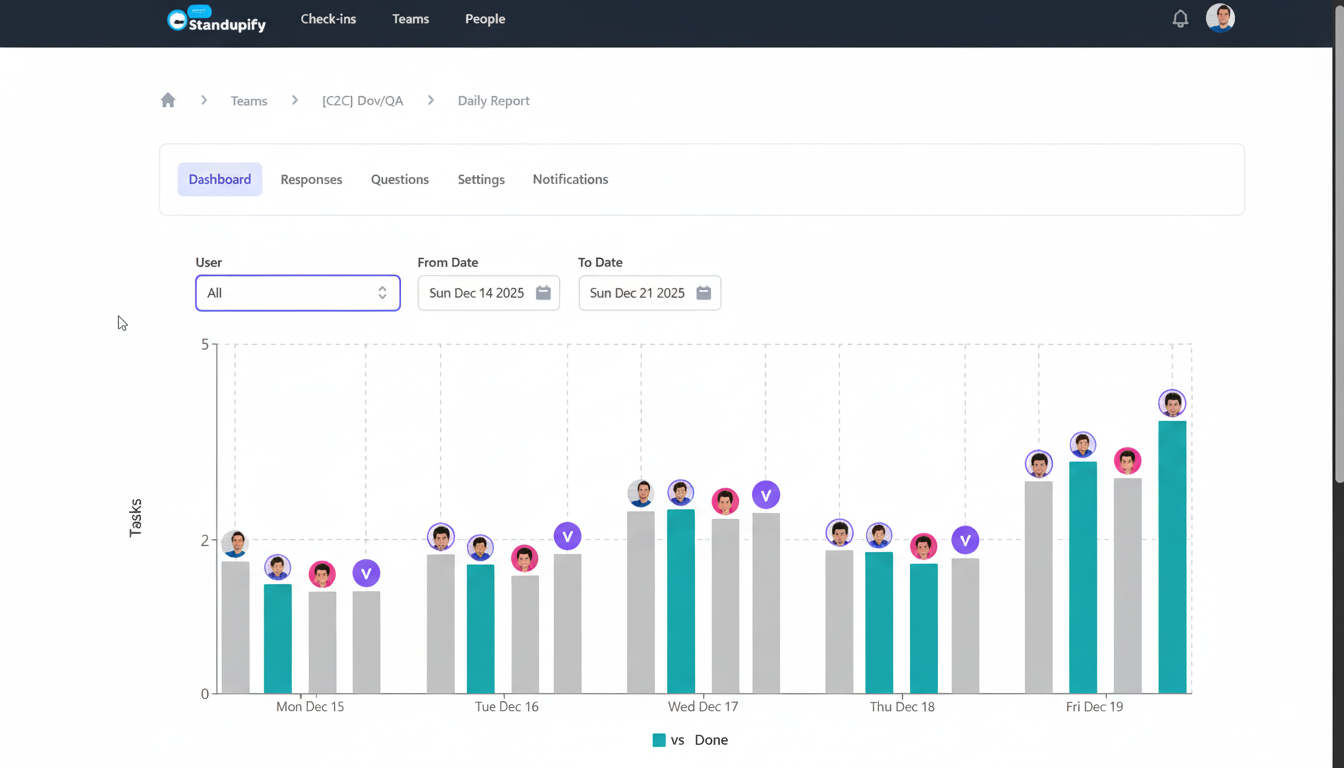
The integration with task trackers means that Standupify doesn’t just collect updates; it connects them directly to your team’s work. This provides a clear, comprehensive view of progress and helps identify potential bottlenecks before they become major blockers. For engineering managers and team leads, this visibility is invaluable. It transforms abstract feelings of overwhelm into concrete, actionable insights, thereby restoring a sense of control over the project's direction and team's well-being. This proactive approach to daily collaboration is essential for elevating your agile stand up meetings and leveraging analytics for better outcomes.
In 2026, the discussion around team productivity must evolve beyond simply 'doing more.' It's about optimizing for sustainable output by respecting human energy, fostering a sense of control, and creating intentional resets. A robust team productivity bot like Standupify is not just a tool for automation; it's a strategic partner in this new era of work, helping your team not just track tasks, but truly thrive.
Looking Ahead: The Subtractive Approach to Team Efficiency
As teams mature, the temptation is always to add more – more tools, more processes, more meetings. But the most effective teams of 2026 are embracing a subtractive approach. Instead of asking, 'What else can we add to be more productive?' they're asking, 'What can we stop doing that drains our energy and sense of control?'
This philosophy extends to annual reviews and quarterly planning. Instead of just setting new goals and adding new habits, teams should actively identify and eliminate practices that no longer serve them. Relying solely on memory for annual reviews is flawed due to recency bias; instead, leverage data from calendars, photos, journals, and even credit card statements to get a more honest picture of the past year. By consciously subtracting energy vampires and inefficient processes, teams create space for higher-value work and sustained well-being. This is how you do an annual review that actually works, as detailed in Stop Adding. Start Subtracting. Here’s How to Do an Annual Review That Actually Works. The future of digital collaboration in 2026, as we've explored, hinges on these nuanced understandings of human and team dynamics. For a broader perspective, you might find our insights on the future of digital collaboration particularly relevant.
The future of team productivity isn't about working harder; it's about working smarter, with a profound understanding of energy, attention, and control. By embracing tools like Standupify and adopting these forward-thinking principles, your team can not only hit its targets but do so with greater clarity, less overwhelm, and a renewed sense of purpose.