Are Your Daily Standups a Bottleneck in the Agentic AI Era?
It's April 23, 2026, and the ground beneath enterprise software is shifting at an unprecedented pace. Just yesterday, Google Cloud Next 2026 unveiled a vision that isn't just about AI tools, but about an entirely new paradigm: agentic AI. Google's CEO, Thomas Kurian, didn't mince words, declaring their strategy as "owning the full stack from chip to inbox," contrasting it sharply with competitors who merely "hand you the pieces, not the platform." This isn't just an upgrade; it's a fundamental re-architecture of how work gets done. So, in a world rapidly embracing AI agents that can autonomously execute complex tasks, we have to ask: are our beloved daily standups becoming more of a bottleneck than a booster to productivity?
For years, the daily standup has been the bedrock of agile teams, a ritual designed to foster transparency, identify blockers, and synchronize efforts. But as AI moves beyond mere assistance to genuine agency, are we holding onto a legacy process that might actually be hindering, rather than helping, standup team effectiveness? Let's dive into the core shifts happening right now and explore how they demand a re-evaluation of our most sacred team rituals.
The Agentic Cloud: Google's Full-Stack Bet
The announcements from Google Cloud Next 2026 are nothing short of transformative. Vertex AI, a name synonymous with Google's AI capabilities, has been rebranded as the Gemini Enterprise Agent Platform. Google Agentspace, the employee-facing AI assistant, is now absorbed into a unified Gemini Enterprise product. This consolidation signals a clear intent: to provide a seamless, integrated platform where AI agents aren't just features, but the very fabric of enterprise operations. As reported by The Next Web, this includes Workspace Studio, a no-code agent builder that promises to put the power of automation into the hands of non-developers. Imagine agents from Box, Workday, Salesforce, and ServiceNow communicating via the new A2A protocol v1.0, already in production at 150 organizations. This isn't theoretical; it's happening now.
What does this mean for your team? It means that many of the "what I did yesterday" and "what I'll do today" updates that fill traditional standups could soon be autonomously generated and shared by AI agents. These agents, connected to your task trackers and communication platforms, can provide real-time, data-driven insights into project progress, potential roadblocks, and resource allocation. The question isn't if this will happen, but when, and how quickly your team adapts.
AI's Double-Edged Sword: Amplifying Capacity and Exposing Bottlenecks
The rise of agentic AI isn't just about enterprise platforms; it's about a fundamental shift in what's possible. Consider the recent news from Mozilla: they released Firefox 150 with fixes for a staggering 271 security vulnerabilities. What's remarkable is that these weren't found by an army of human researchers, but by Anthropic’s Claude Mythos Preview, a frontier AI model. Mozilla's CTO, Bobby Holley, asserted that these defects are "finite" and that defenders can "finally find them all" with AI. This demonstrates AI's incredible power to scour vast datasets and identify previously unseen inefficiencies or vulnerabilities at a scale and speed impossible for humans.
However, this power isn't exclusively for good. Just this week, Wired revealed how AI tools are helping "mediocre" North Korean hackers steal millions. One group, HexagonalRodent, used AI from companies like OpenAI and Cursor to "vibe code" malware and build fake websites, stealing up to $12 million in three months. This stark contrast highlights a critical truth: AI amplifies existing human capabilities, for better or worse. It democratizes power. For teams, this means AI can expose and help resolve bottlenecks with unprecedented efficiency, but it also demands that we rethink our processes to prevent new forms of inefficiency or information overload.
The Data Layer: The Unseen Bottleneck in the AI Era
While we marvel at the capabilities of AI models, the true unsung hero – or often, the hidden villain – is the data layer. VAST Data, a company focused on data infrastructure, recently raised $1 billion at a staggering $30 billion valuation, tripling its value from late 2023. This isn't a bet on a foundational model or a cloud provider; it's a bet that "the data layer is the real bottleneck in AI," as The Next Web aptly put it. NVIDIA's Jensen Huang himself endorsed VAST's mission to ensure data reaches processors fast enough. Without efficient data flow, even the most advanced AI grinds to a halt.
This principle applies directly to human teams. If AI agents are the "processors" of information, then our internal communication channels and task management systems are the "data layer." If this layer is inefficient – if information is siloed, incomplete, or delayed – then even the most sophisticated AI-powered tools won't deliver on their promise. This is where the traditional standup, often a snapshot of yesterday's work and today's intentions, can fall short. It's a manual data pipeline in an increasingly automated world.
Reimagining Standups for True Standup Team Effectiveness
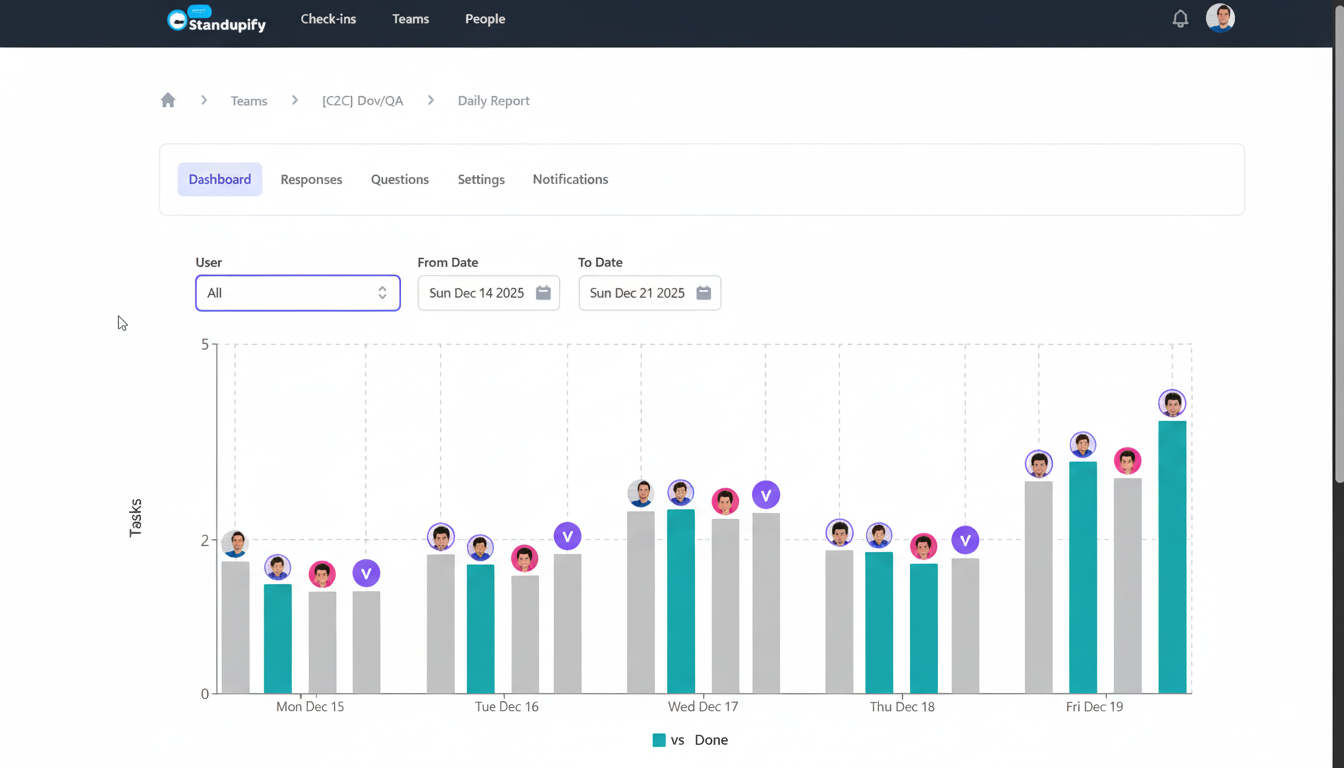
So, if AI agents are poised to automate many of the informational updates, what's the future of the daily standup? It's not about elimination, but evolution. The focus must shift from mere reporting to proactive problem-solving, strategic alignment, and genuine human connection. Imagine a world where your team standup bot, integrated with your task tracker, has already compiled a concise summary of everyone's progress, identified potential blockers based on dependencies, and even flagged tasks that are falling behind schedule.
- Automated Pre-briefs: Before the standup, an AI agent could generate a summary of key metrics, completed tasks, and predicted challenges, freeing up valuable meeting time.
- Proactive Blocker Identification: Instead of waiting for someone to state a blocker, an AI agent could analyze project dependencies and task statuses to flag potential issues before they even arise, allowing the team to focus discussions on solutions.
- Intelligent Question Generation: The bot could suggest pertinent questions for the team to discuss based on project health, newly introduced tasks, or external factors.
- Focus on Solutions, Not Status: With status updates automated, the standup can become a true working session, leveraging human creativity and problem-solving skills where they matter most.
This approach transforms the standup from a passive information dump into an active, high-value strategy session. It moves beyond just tracking what happened to anticipating what will happen, and equipping teams to respond proactively. For more on this forward-thinking approach, consider delving into The Future of Team Productivity: Reclaiming Energy and Control in 2026.
Standupify's Vision: The Intelligent Standup
At Standupify, we believe the future of team productivity lies in intelligent automation that empowers, rather than replaces, human collaboration. Our Google Chat bot for daily standups is designed precisely for this evolving landscape. By seamlessly integrating with your task tracking systems, Standupify provides the comprehensive view of team progress and blockers that AI agents will thrive on. It lays the groundwork for a future where your daily updates are streamlined, insightful, and contribute directly to enhanced standup team effectiveness.
We're not just automating the existing process; we're building the infrastructure for the next generation of team interactions. Think about how a smart Google Chat bot can elevate your agile stand-up meetings today, by providing analytics and insights that pave the way for agentic intelligence tomorrow.
Conclusion: Embrace the Evolution
The agentic AI era isn't a distant dream; it's here. As Google and others push full-stack AI platforms, and as AI demonstrates its capacity to both solve complex problems and amplify human intent, we must critically examine our established rituals. Are your daily standups truly optimizing for speed, transparency, and problem-solving, or are they a manual bottleneck in an increasingly automated world?
The answer isn't to abandon standups, but to reimagine them. By leveraging intelligent automation and AI agents, teams can transform these meetings from routine status updates into dynamic, high-impact sessions focused on strategic progress and genuine collaboration. The future of productivity demands that we adapt, not just adopt, the powerful tools at our disposal. It's time to let AI handle the mundane, so your team can focus on what truly matters.