Is AI Productivity a Mirage? Engineering Leaders Face the 2026 Reality Check
As 2025 draws to a close, engineering leaders find themselves under increasing pressure. The era of simply experimenting with AI is over. Now, Chief Financial Officers (CFOs) and boards are demanding tangible proof that AI investments are translating into measurable gains in productivity, quality, and customer value. But is this a realistic expectation, or are we chasing a mirage of AI-driven efficiency?
The End of the AI Honeymoon
For the past few years, AI has been the shiny new toy in the engineering world. Companies have eagerly adopted AI tools, launched pilot programs, and celebrated increased adoption rates. However, according to a recent article in TNW (The Next Web), now owned by Tekpon, this grace period is coming to an end. The article, Engineering’s AI reality check, highlights the growing need for engineering leaders to demonstrate the real impact of AI spend with verifiable data. Boards and CFOs are no longer satisfied with vague promises; they want to see a direct link between AI investments and improved outcomes.
The challenge lies in accurately measuring the impact of AI across the Software Development Life Cycle (SDLC). While developers might report time savings on coding tasks, it’s crucial to understand where AI is actually being used, how much capacity it’s freeing up, and how it’s affecting overall delivery speed and quality. Without this level of granularity, it’s impossible to determine whether AI investments are truly paying off.
The Pressure to Prove AI's Value
The shift in expectations is driven by a broader trend of increased scrutiny on technology investments. As TechCrunch reports, even AI giants like OpenAI are facing pressure to justify their massive valuations. OpenAI is reportedly seeking to raise $100 billion at an $830 billion valuation, a move that underscores the immense capital required to stay ahead in the AI race. However, as investor sentiment cools, there's growing concern about whether the pace of debt-fueled investment can be sustained. Every dollar spent on AI will need a traceable path to productivity, quality, or customer value.
This pressure is amplified by the increasing competition in the AI landscape. With companies like Google launching new AI models like Gemini 3 Flash, the pressure is on to innovate and deliver tangible results. Gemini 3 Flash, for example, is now the default model in the Gemini app, boasting significant improvements over its predecessor. The company is also making this the default model in the Gemini app and AI mode in search. This constant push for innovation requires significant investment, making it even more critical to demonstrate the return on that investment.
Strategies for Demonstrating AI Impact
So, how can engineering leaders effectively demonstrate the impact of AI investments? Here are a few strategies:
1. Establish Clear Metrics
Define specific, measurable, achievable, relevant, and time-bound (SMART) metrics for AI initiatives. These metrics should align with key business objectives, such as increased productivity, improved quality, faster time to market, or enhanced customer satisfaction.
2. Track AI Usage Across the SDLC
Implement systems to track where AI tools are being used throughout the SDLC. This includes coding, testing, deployment, and maintenance. By monitoring usage patterns, you can identify areas where AI is having the greatest impact and areas where it may be underutilized.
3. Measure Capacity Freed Up by AI
Quantify the amount of capacity that AI is freeing up for developers and other team members. This could be measured in terms of time saved, tasks automated, or reduced errors. By demonstrating the capacity gains, you can show how AI is enabling teams to focus on higher-value activities.
4. Analyze the Impact on Delivery Speed and Quality
Assess how AI is affecting delivery speed and quality. Are projects being completed faster? Are there fewer bugs and defects? Are customers more satisfied with the end product? By analyzing these metrics, you can demonstrate the overall impact of AI on the software development process.
5. Integrate AI into Standup Meetings
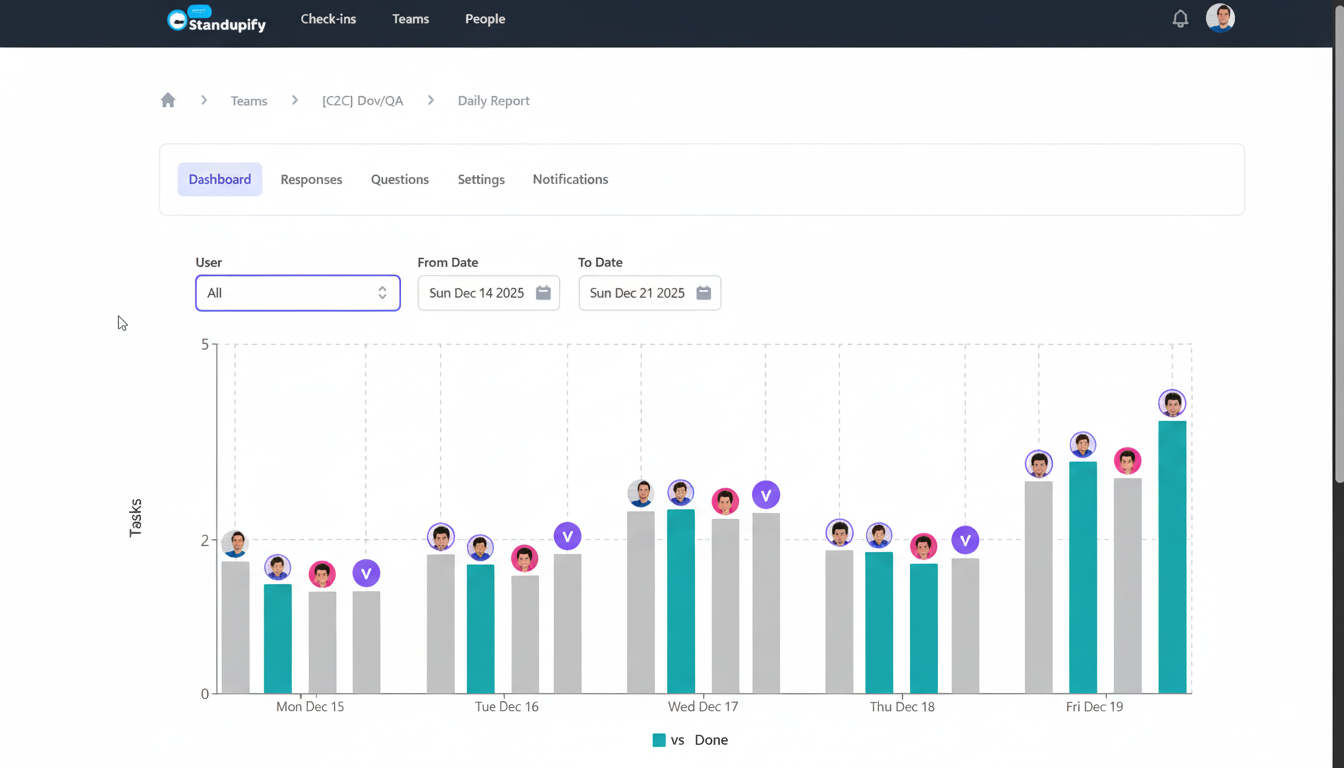
Leverage AI-powered tools like Standupify to streamline daily standup meetings and track team progress. An engineering standup bot can automate the process of collecting updates, identifying blockers, and generating reports, providing valuable insights into team performance and project status. Using standup best practices with an AI-powered bot can significantly improve team communication and efficiency.
The Role of Standupify in the AI-Driven Engineering Landscape
Standupify is uniquely positioned to help engineering teams navigate the challenges of demonstrating AI impact. By integrating seamlessly with task tracking systems and automating the standup process, Standupify provides a comprehensive view of team progress, blockers, and overall performance. This data-driven approach enables engineering leaders to make informed decisions, optimize resource allocation, and demonstrate the tangible benefits of AI investments.
Furthermore, Standupify helps teams adopt proven strategies to supercharge team performance in 2026 by providing a structured and efficient way to track progress, identify bottlenecks, and foster collaboration. By using Standupify, teams can ensure that their daily standups are focused, productive, and aligned with overall business objectives.
In the face of increasing pressure to demonstrate the value of AI investments, engineering leaders need to embrace a data-driven approach. By establishing clear metrics, tracking AI usage, measuring capacity gains, and analyzing the impact on delivery speed and quality, they can effectively showcase the tangible benefits of AI. Tools like Standupify can play a critical role in this process by providing the insights and automation needed to optimize team performance and drive measurable results. As we move into 2026, the ability to prove AI's value will be the key to unlocking its full potential.
The Future of AI in Engineering
The future of AI in engineering is not about replacing human engineers, but about augmenting their capabilities and empowering them to achieve more. By automating mundane tasks, providing intelligent insights, and facilitating seamless collaboration, AI can help engineering teams become more efficient, innovative, and customer-focused. However, realizing this vision requires a strategic approach that focuses on delivering measurable results and demonstrating the tangible value of AI investments. As explored in The AI-Powered Standup: Revolutionizing Team Productivity in 2026, the integration of AI into daily workflows is becoming increasingly crucial.
Ultimately, the success of AI in engineering will depend on the ability of engineering leaders to embrace a culture of data-driven decision-making and continuous improvement. By leveraging the power of AI-powered tools and adopting best practices for team collaboration, engineering teams can unlock new levels of productivity, quality, and customer value. The time for experimentation is over; the time for demonstrating tangible results is now.