How to Get Developers to Break Down Large Jira Epics
As a Scrum Master, you've likely encountered the frustratingly vague daily update: "Still working on X." This common phrase, while seemingly innocuous, often signals a deeper issue: a large, undifferentiated task that's hard to track, estimate, and, most importantly, complete. This guide will equip you with strategies to help your development team break down large Jira epics into manageable, daily tasks, fostering a culture of continuous progress and clear communication.
The Problem: The Vague "Still Working on X"
When developers are tackling massive Jira epics without clear sub-tasks, daily standups can become repetitive and uninformative. "Still working on X" provides little insight into progress, potential blockers, or estimated completion. This lack of granularity can lead to:
- Reduced visibility for the team and stakeholders.
- Difficulty in identifying and addressing blockers promptly.
- Decreased team morale due to a perceived lack of progress.
- Inaccurate sprint forecasting and planning.
The Psychology of Daily Wins
Humans are motivated by progress. The feeling of completing a task, no matter how small, triggers a sense of accomplishment and boosts morale. In an agile environment, this translates to the power of "daily wins." Agile tasks should ideally take 1-2 days to complete to maintain momentum. When tasks are broken down to this level, developers experience frequent successes, which:
- Increases motivation and engagement.
- Enhances psychological safety by making progress visible and reducing the pressure of an insurmountable task.
- Provides clearer data for future estimations and planning.
How to Decompose Jira Epics into 1-Day Tasks
Guiding your team through epic decomposition requires a structured approach. Here's how to facilitate this process:
- Understand the Epic's "Definition of Done": Before breaking anything down, ensure everyone has a shared understanding of what constitutes a completed epic. What are the key outcomes and acceptance criteria?
- Break into Smaller User Stories/Features: An epic is a large body of work. Decompose it into smaller, independent user stories or features that deliver specific value. Each story should have its own "Definition of Done."
- Decompose Stories into 1-2 Day Sub-tasks: This is the crucial step. For each user story, work with your developers to identify the individual, actionable steps required to complete it. Each sub-task should be small enough to be completed within one to two days. Examples include:
- "Set up database schema for feature Y"
- "Implement API endpoint for user authentication"
- "Write unit tests for component Z"
- "Create UI mockups for screen A"
- Estimate and Commit: Once sub-tasks are identified, have the team estimate them. This helps validate their size and fosters commitment. If a sub-task still feels too large, break it down further.
- Refine Continuously: Task decomposition isn't a one-time event. Continuously refine tasks during sprint planning and daily standups as new information emerges.
Leveraging Standupify's "Done" Task Filter to Enforce Habits
Standupify's powerful Jira integration is designed to support this agile practice. By connecting Standupify to your Jira instance, you can automatically pull relevant tasks into your daily standup reports, making it easier for developers to report on specific, smaller items.
To reinforce the habit of breaking down tasks and celebrating daily wins:
- Connect Standupify to Jira: If you haven't already, ensure your Standupify instance is connected to Jira. Learn how to connect Standupify to Jira for automated daily reports.
- Configure Your Task List: Ensure your Standupify daily standup questions are configured to pull in tasks that are relevant to the current sprint and team. Focus on tasks that are "In Progress" or "To Do."
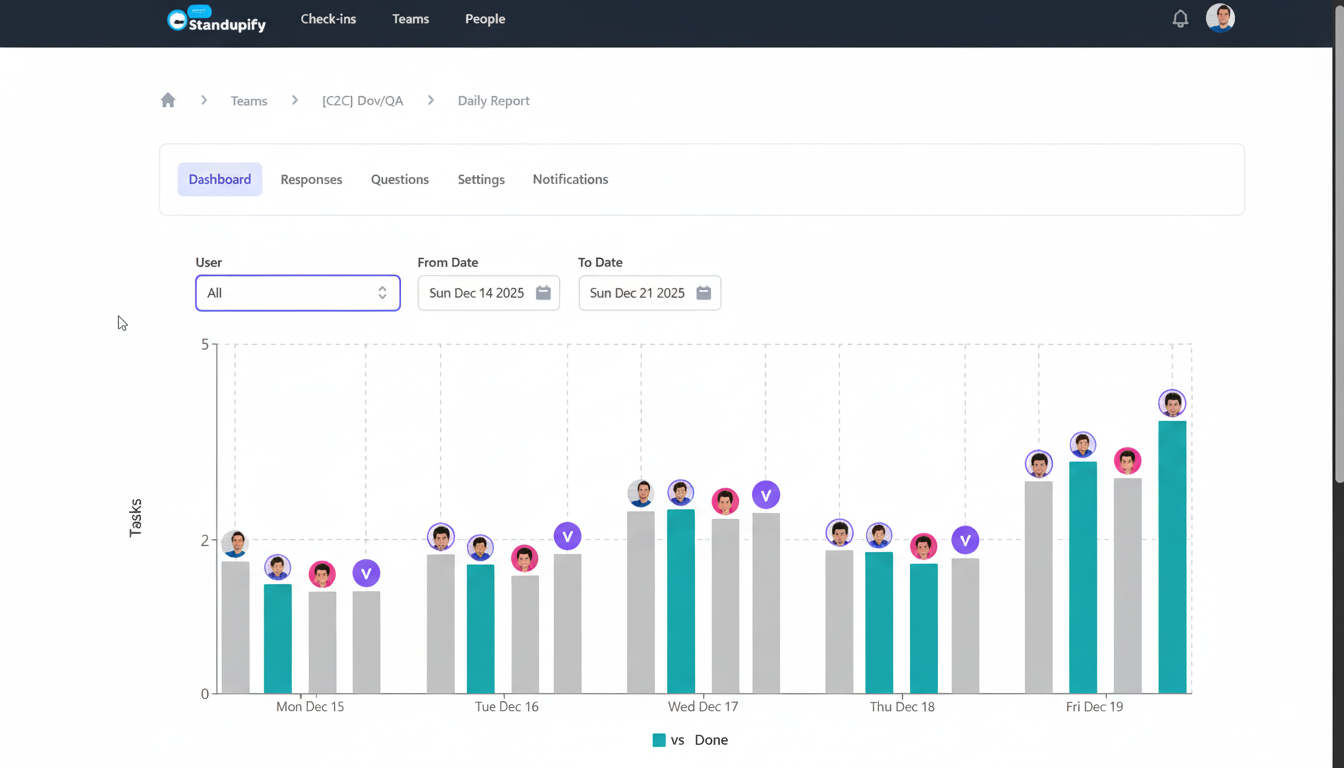
- Utilize the "Done" Task Filter: Standupify allows you to filter and view tasks marked as "Done" within a specific period. Encourage your team to actively mark their small, 1-2 day tasks as "Done" in Jira. This provides immediate visual feedback of progress, both for the individual and the team. Tracking daily 'Done' tasks significantly boosts team morale and psychological safety.
- Review Daily Reports: As a Scrum Master, regularly review the Daily Report Dashboard in Standupify. Look for consistent completion of smaller tasks rather than prolonged "in progress" statuses on large items. This helps you identify if the decomposition strategy is working and where further coaching might be needed.
By making daily progress visible and celebrating these smaller accomplishments, Standupify helps solidify the habit of effective task breakdown.
Conclusion
Breaking down large Jira epics into 1-2 day tasks is a cornerstone of effective agile development. It transforms vague updates into clear progress, boosts developer morale through daily wins, and provides invaluable visibility for the entire team. By implementing these decomposition strategies and leveraging Standupify's Jira integration, you can cultivate a more productive, transparent, and motivated development team.
Frequently asked questions
Why is it so important to break down large Jira epics into smaller tasks?
Breaking down epics into 1-2 day tasks provides clearer visibility into progress, helps identify blockers sooner, boosts developer morale through frequent "daily wins," and improves the accuracy of sprint planning and forecasting.
What is the ideal size for a Jira task in an agile environment?
Ideally, an agile task should be small enough to be completed within 1-2 days. This promotes continuous progress, makes daily standups more informative, and enhances team motivation.
How can Standupify help Scrum Masters enforce task breakdown habits?
Standupify integrates with Jira to pull relevant tasks into daily reports. By configuring standup questions to focus on current tasks and utilizing Standupify's "Done" task filter, Scrum Masters can encourage and track the completion of smaller, daily tasks, making progress visible and reinforcing good habits.
What if my developers struggle to break down tasks effectively?
This is a common challenge. As a Scrum Master, facilitate collaborative decomposition sessions. Ask guiding questions like "What's the very first concrete step?" or "What's the smallest valuable piece we can deliver?" Encourage pair programming for complex tasks and provide examples of well-decomposed tasks.
How often should we review and refine our task breakdown process?
Task decomposition should be an ongoing process. Review and refine it during sprint planning, daily standups, and sprint retrospectives. Use the insights from Standupify's daily reports to identify areas for improvement in task sizing and reporting.