The Psychology of Progress: How to Motivate Your Dev Team Every Morning
As a Team Lead, you're constantly seeking ways to energize your development team. Daily standups, while essential for alignment, can sometimes inadvertently create an 'illusion of progress' that saps motivation rather than fuels it. Understanding the psychology behind progress can transform your morning check-ins from a mundane ritual into a powerful motivational tool.
The "Illusion of Progress" in Daily Standups
Imagine a developer reporting the same task as 'in progress' for several days in a row. While they are indeed working diligently, the repetitive status update can create an 'illusion of progress.' The task isn't done, it's just... still being worked on. For the individual and the team, this can feel like running on a treadmill – lots of effort, but no visible movement forward.
Why Repeating Status Updates Demotivates
Human psychology thrives on accomplishment. The 'progress principle' states that making visible headway in meaningful work is the #1 motivator for employees. When standups are dominated by updates on tasks that are perpetually 'in progress,' this fundamental psychological trigger is missed. Team members might feel their contributions aren't tangible, leading to a dip in morale and a sense of stagnation. It's not about the effort, but the perceived lack of closure.
The Psychological Trigger of Reporting Only Closed/Resolved Tasks
The solution lies in shifting the focus. Instead of asking, "What did you work on yesterday?" consider asking, "What did you complete yesterday?" This subtle change in framing has a profound psychological impact. Reporting only closed or resolved tasks:
- Provides a sense of accomplishment: Each reported completion is a mini-victory.
- Reinforces positive behavior: It encourages developers to break down work into shippable chunks.
- Creates visible momentum: The team collectively sees a growing list of 'done' items.
- Boosts morale: A team that consistently sees tangible progress is a motivated team.
In fact, teams that use strict task decomposition and focus on completion have been observed to ship up to 25% faster, directly benefiting from this psychological boost.
How Standupify Implements This Constraint
Standupify is designed to harness the power of the progress principle, especially when integrated with Jira. Instead of relying on manual, often vague, updates, Standupify can be configured to automatically pull relevant information directly from your Jira projects. This allows you to:
- Focus on completion: Configure your daily standup questions to specifically query for tasks that were moved to 'Done,' 'Resolved,' or 'Closed' statuses in Jira since the last standup.
- Automate reporting: With Standupify's Jira integration, team members don't have to manually recall and type out every completed item. Standupify does the heavy lifting, presenting them with a concise list of their achievements.
- Customize your queries: Use Jira JQL (Jira Query Language) within Standupify to define precisely what constitutes a 'completed' task for your team, ensuring relevance and accuracy. You can also configure your task list to align with your team's workflow.
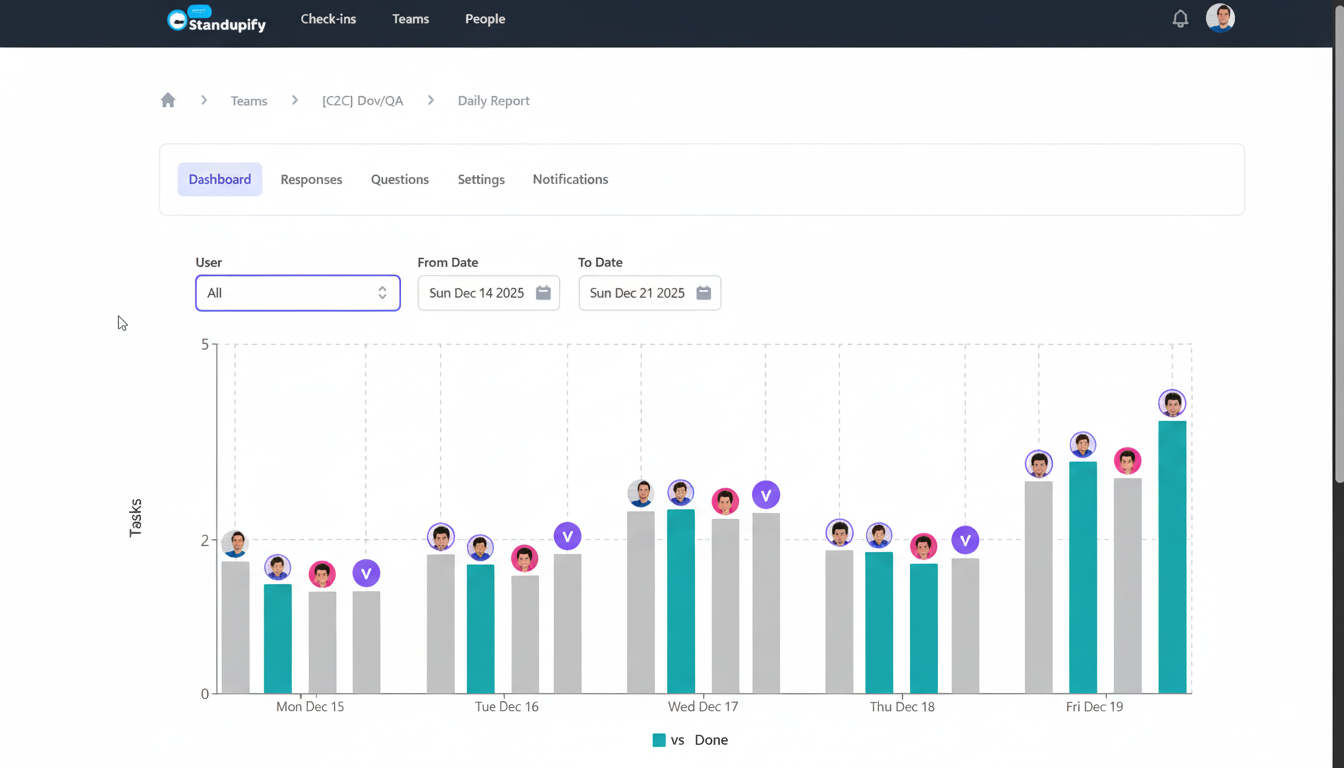
- Visualize progress: The Daily Report Dashboard offers a clear overview of completed tasks across your team, making collective progress immediately visible to everyone.
By integrating with Jira and focusing on completed tasks, Standupify helps you move beyond the 'illusion of progress' and into a realm of tangible, motivating achievements.
Conclusion
Motivating your dev team every morning doesn't require complex incentives; it requires understanding fundamental human psychology. By shifting the focus of your daily standups from ongoing work to completed tasks, you tap into the powerful 'progress principle.' Standupify, with its smart Jira integration, provides the tools to implement this effectively, transforming your standups into a daily dose of motivation and a clear indicator of genuine progress.
Frequently asked questions
What is the 'illusion of progress' in daily standups?
The 'illusion of progress' occurs when team members repeatedly report on tasks that are still 'in progress' day after day. While work is being done, the lack of visible completion can make it feel like little actual progress is being made, leading to demotivation.
Why is reporting only completed tasks more motivating?
Reporting only completed tasks taps into the 'progress principle,' which states that making visible headway is the #1 motivator. It provides a clear sense of accomplishment, reinforces positive behavior, and helps the team see tangible results, fostering a more positive and productive environment.
How does Standupify help enforce this 'completed tasks only' rule?
Standupify, especially with its Jira integration, allows you to configure standup questions and JQL queries to automatically pull only resolved or closed tasks from the previous day. This streamlines the reporting process and naturally guides team members to focus on what they've shipped.
Can my team still discuss blockers if we only report completed tasks?
Absolutely. While the focus of the 'what did you do yesterday?' question shifts to completed items, standups still provide a crucial forum for discussing 'what will you do today?' and 'are there any blockers?' Standupify's customizable questions ensure you can still capture and address impediments effectively.
What if my team works on long-running tasks that aren't completed daily?
For long-running tasks, the key is to break them down into smaller, shippable sub-tasks or milestones. This allows team members to report meaningful completions daily or every few days, maintaining the psychological benefit of progress. Standupify's flexible configuration supports this approach.